
If you sell into the baby or household category, you have probably been pitched at least four different product award seals this year. Some cost a few hundred dollars. Some cost several thousand. A few send you a logo within two weeks of paying. And you have almost certainly asked the question every marketer in this category eventually asks: does any of this actually move product, or is it just a sticker?
Here is the short answer, and then we will unpack all of it.
Safety certifications and product award seals are not the same thing
Safety certifications prove your product will not hurt anyone. Award seals prove somebody chose it over the alternatives. Retail buyers, registry editors and parents are looking for both, and they read them very differently. The credibility problem most brands have is not that they are missing a seal. It is that they have the compliance side covered and nothing on the preference side.
One disclosure before we go further: Parent Tested Parent Approved is one of the programs in this landscape. We have been certifying products through in-home parent testing since 2007. We have tried to describe the other programs fairly and accurately, because a guide that only flatters the publisher is not worth reading. Verify everything here directly with each program before you commit budget.
The three types of trust signal, and what each one actually proves
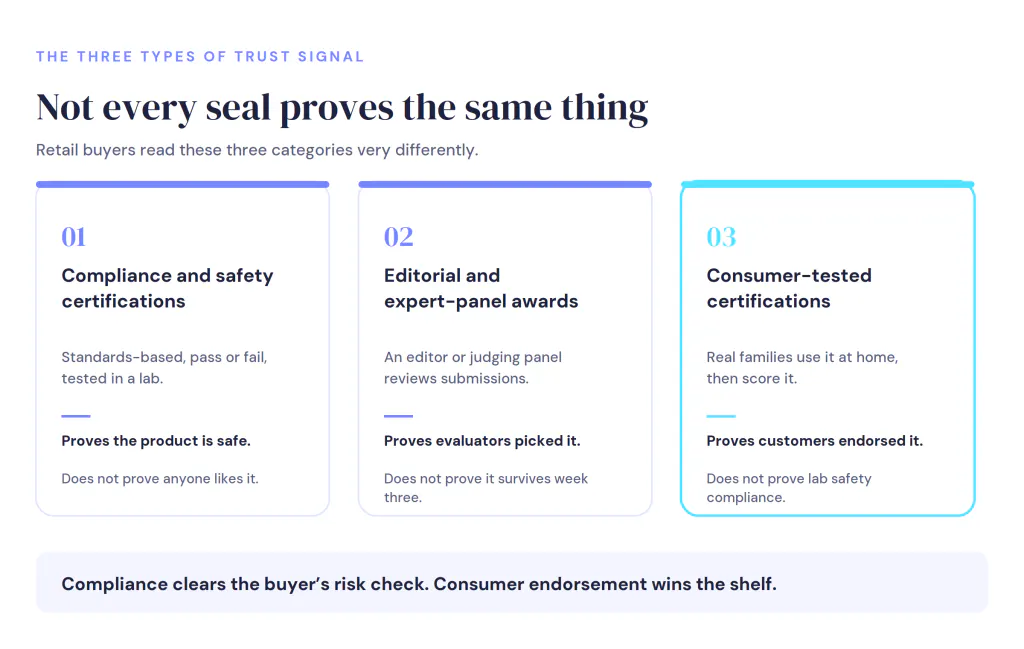
Most brands lump every logo on their packaging into one mental bucket called “credentials.” Retail buyers do not. There are three distinct categories, and confusing them is where marketing budgets go to die.
1. Compliance and safety certifications
These are standards-based, pass or fail, and a lab does the testing. GREENGUARD Gold, OEKO-TEX Standard 100, GOTS, Baby Safety Alliance Verification (the program you may still know as JPMA certification), EWG Verified, Clean Label Project. A product either meets the emissions threshold or it does not. There is no judgement involved and no comparison to competitors.
What it proves: your product is safe and meets a defined standard.
What it does not prove: that anyone likes it, that it works well, or that a parent would buy it twice.
2. Editorial and expert-panel awards
A publication, an editorial team, or a panel of judges evaluates submissions against criteria and selects winners. Good Housekeeping, National Parenting Product Awards, Mom’s Choice Awards. Evaluation quality varies enormously across these, from serious lab work to a small review committee.
What it proves: an informed group of evaluators picked your product.
What it does not prove: how the product performs over eight weeks in a house with a toddler, a dog and no time.
3. Consumer-tested certifications
Real families receive the product, use it in their own homes over a defined period, and score it. Aggregated consumer scores determine the award, not an editor. This is the category Parent Tested Parent Approved sits in.
What it proves: actual target customers used it in real conditions and endorsed it.
What it does not prove: laboratory safety compliance. You still need your safety certifications. A consumer-tested seal is not a substitute for Baby Safety Alliance Verification or GREENGUARD, and any program that suggests otherwise is misleading you.
Where the evaluation actually happens
The brands that get real lift pair a compliance certification with a consumer-tested one. Compliance clears the buyer’s risk check. Consumer endorsement wins the shelf.
The distinction that matters most inside the second and third categories is where evaluation actually happens. A panel reviewing a submission is forming an impression. A family using the product for weeks is generating evidence. Both produce a seal. Only one of them can tell you what happens in week three, when the novelty is gone and the product has to keep earning its place on the counter.
Two currency checks worth doing on your own materials
The Parents’ Choice Award ran from 1978 until the Parents’ Choice Foundation closed on July 31, 2022, so nobody issues it anymore. And in June 2025 the Juvenile Products Manufacturers Association became the Baby Safety Alliance, so JPMA Certification is now Baby Safety Alliance Verification. Same testing, new seal.
What retail buyers are actually looking at
This is the part nobody tells you, so here it is plainly.
The three things a seal does for a buyer
A category buyer at a major retailer does not feel much of anything about your seal. They are managing risk and forecasting velocity. A seal helps them in three specific ways, and only three.
It reduces perceived risk on a new listing. An unfamiliar brand with third-party validation is an easier yes than an unfamiliar brand without it. The buyer needs something to point to when they defend the listing internally.
It gives them merchandising ammunition. Retailers are building award-winning and highly-rated filters, badges and curated sections into their category pages and registries. A recognized seal is what makes a product eligible for that placement. If you have no third-party recognition, those modules exclude you structurally, no matter how good the product is.
It supports the enhanced content on the product page. Conversion on a baby product page is a trust problem, not an information problem. Parents are not confused about what a bottle warmer does. They are trying to figure out which one will not disappoint them. A seal in the image carousel answers that faster than another paragraph of copy.

What buyers do not check, and who does
Buyers are not auditing your award program’s methodology. Which is exactly why the methodology matters to you. Parents increasingly do audit it, and so do the AI assistants they now ask for recommendations. When a shopper asks an assistant “is this seal legitimate,” the answer comes from whatever that program has publicly documented about how it selects winners. Thin methodology, thin answer.
Seven questions to ask any award program before you submit
Print this. Ask every program the same seven questions and compare the answers side by side. The ones that answer clearly are the ones worth your money.
Questions about how the program works
- Can a product fail? This is the single most important question. If every paying submission wins, the seal means nothing and eventually somebody will write about it. Ask for the actual pass rate, and ask what happens to your fee and your data when a product does not win. A program that has thought carefully about the failure case is a program where failure happens. Our full methodology, including what disqualifies a product outright, is published at how we test.
- Who evaluates, and how many of them? One editor is a very different thing from twenty families. Neither is automatically better, but you should know which you are buying.
- Where does evaluation happen? A product that sits on a reviewer’s desk behaves differently than a product a family uses for six weeks in a real household. For anything with a durability, ease-of-use or repeat-use dimension, in-home testing tells you far more. Ours is documented in full here.
- Do I get the underlying data? A logo is worth something. A logo plus a market research report is worth considerably more. The scored consumer feedback behind it feeds product development, ad copy, retailer decks and your next launch.
Questions about terms and recognition
- What are the licensing terms? How long can you use the seal, on what, and what happens when it lapses. Annual licensing is common, and it is not a drawback. A seal that renews reflects the product being sold today. A perpetual seal can sit on a package the brand has reformulated or re-sourced three times since it won. What matters is that the terms are clear before you commit to a print run.
- Is the award listing public and crawlable? Separate from the seal license, ask what your award page on their site actually looks like. It should be a real indexable page that links to you, not a name inside a script that search engines and AI assistants cannot read. That page is a backlink and a citation source, and it matters increasingly now that assistants answer product questions by reading what is publicly published. Expect listings to track active certification. That follows the same logic as a renewing license. A live award page for a product that no longer holds the seal misleads the parent reading it.
- Will a retail buyer recognize it? Ask for the list of retailers where the seal already appears in merchandising, and ask which enterprise brands have used it. Recognition is the whole point.

Where Parent Tested Parent Approved fits
Since we are one of the options, here is our model stated plainly so you can hold it against the seven questions.
How the testing works
Select families from our community of 250,000 test each product in their own homes. We match testers to your actual target audience rather than using a general panel. They live with the product, then score it across quality, dependability and overall value. We aggregate those scores, and the aggregate determines whether the product earns certification.
Products can fail, and here is the proof
There is no voting, and there is no pay-to-play. A brand pays for the testing process, not for the outcome, and the product has to earn the seal against our standards. That distinction is the entire reason the seal carries weight after eighteen years, and it is the one thing we will not compromise on.
The clearest evidence that failure is real is what happens when it does. If a product does not earn certification, we refund 75 percent of the fee and the brand still receives the full market research report. The quarter we retain covers the testing we actually performed. Nobody builds that mechanism for an outcome that never occurs, and a brand that fails walks away knowing precisely why, which is the more useful half of the transaction.
The report matters as much as the seal
Every brand receives a market research report on the testing, which is frequently more valuable than the seal itself. Your real customer tells you what confused them, what delighted them, and what nearly made them return it. Those verbatim comments change packaging copy faster than any focus group.
Who has carried the seal
P&G, SC Johnson, Mattel, Dr. Brown’s, Angelcare, and Graco, have all carried the certification. So have hundreds of emerging brands who needed a credibility signal before they had a name. Our certification FAQ answers the practical questions in detail, including timelines, what brands receive and what happens when a product does not pass.
You can see how winners use the seal across packaging, retail listings and advertising on our Certification In Use page, or browse current award winners by category.
Common questions
Do product award seals actually increase sales?
The honest answer is that a seal on its own does very little. A seal deployed properly does a lot. Deployed properly means five places. Your main product image or carousel. The front of the package. The first screen of your Amazon A+ content. Your retailer sell sheet. Your paid creative. Brands that treat a seal as a website footer element see nothing. Brands that put it where the purchase decision happens see movement.
How many seals is too many?
Two or three that are genuinely relevant beats six that look like clip art. A cluster of unfamiliar logos reads as compensating. Choose one safety certification that matters for your material or category, and one consumer or editorial award that a shopper recognizes.
Do I need a safety certification and an award seal?
For baby products, effectively yes. Safety certification is now table stakes for buyer conversations and for the more informed segment of parents. It is a floor, not a differentiator, because your competitor has it too. The award seal is what distinguishes you once everyone has cleared the floor.
Are parent-tested awards credible if brands pay to enter?
Fee for entry is standard across essentially every award program in every industry, because testing has real costs. The credibility question is not whether money changes hands. It is whether money guarantees the outcome. Ask what percentage of submissions win. A program that cannot or will not tell you is telling you something.
When should I start the certification process?
Before launch, not after. A seal is most valuable on day one of a listing. The product has no reviews, no ratings and no sales history for a shopper to lean on. That is the window where third-party validation does the most work. It is also the window most brands miss, because they treat awards as something to chase once a product is already struggling.
Choosing well
The category is crowded with seals because the seals work, and when something works, plenty of people will sell you a version that only looks like it. That is not a reason to skip third-party validation. It is a reason to interrogate it.
Ask the seven questions. Compare methodology instead of price. Pick the credential that would survive a curious parent googling it at eleven at night with a baby on her shoulder, because that is the actual test.
And whichever program you choose, put the seal where the decision happens.
Thinking about certification for your product? Reach out to PTPA for more details and they will walk you through how testing works for your specific category.